
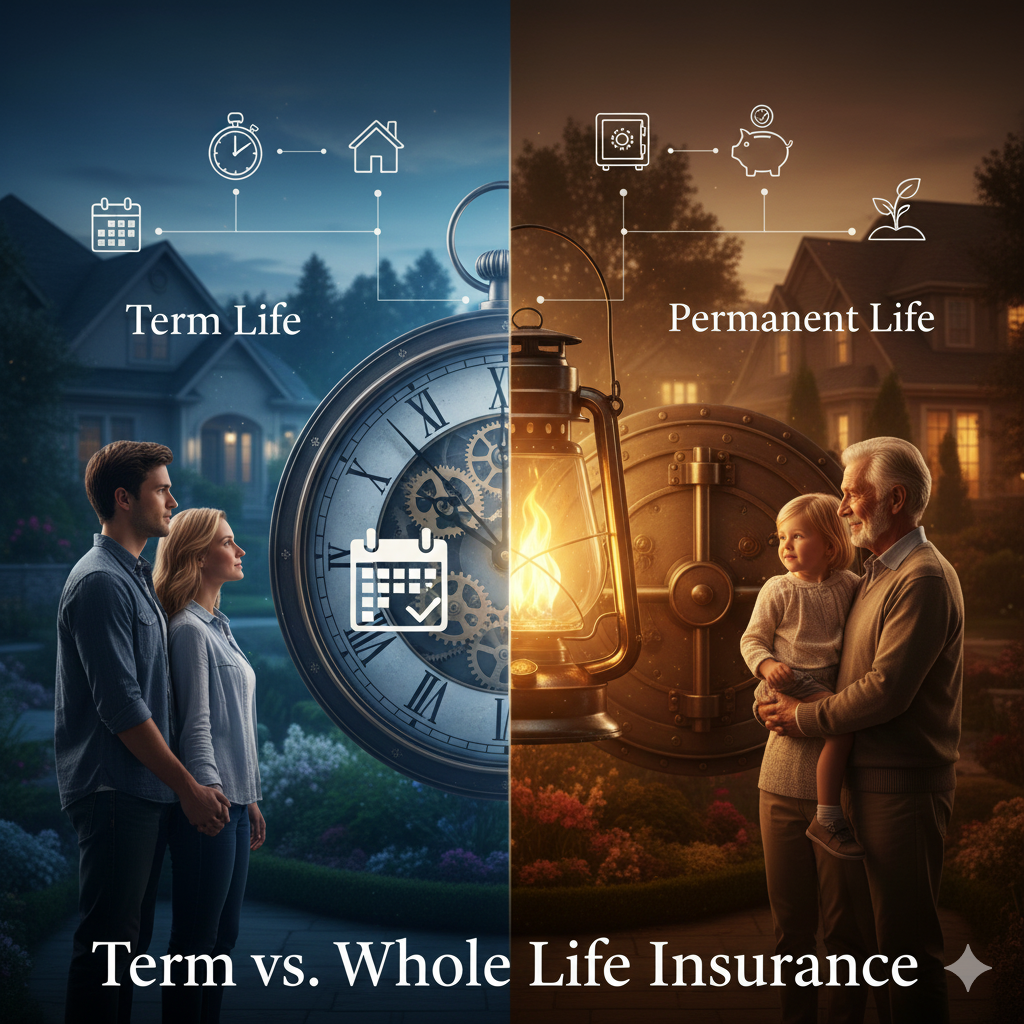
If you’re stuck choosing term vs whole life insurance, you’re not alone. These two types look similar on the surface—both pay money to your beneficiaries if you die—but they work very differently, cost very differently, and fit different goals.
Here’s the simplest way to think about it:
- Term life = affordable coverage for a set time (10/20/30 years)
- Whole life = lifelong coverage with extra features (often cash value), usually at a higher cost
In this guide, we’ll compare term vs whole life insurance in plain language with examples, pros and cons, and a checklist so you can choose confidently.
Country note: Policy features and names can vary by country and insurer, but the core differences explained below are broadly the same.
“If you’re still new, start with what life insurance is.”
Table of Contents
Quick comparison: term vs whole life insurance
| Feature | Term Life Insurance | Whole Life Insurance |
|---|---|---|
| Coverage length | Fixed term (e.g., 20 years) | Usually lifetime (if premiums paid) |
| Main purpose | Income replacement | Lifetime protection + long-term planning |
| Cost | Usually lower | Usually much higher |
| Cash value | No | Often yes (policy-dependent) |
| Complexity | Simple | More complex |
| Best for | Most families | Specific long-term needs |
What is term life insurance?
Term life insurance covers you for a set time period. If you die during the term, your beneficiary gets the payout (death benefit). If the term ends and you’re still alive, coverage usually ends unless you renew or convert the policy.
Pros of term life insurance
- Affordable way to get high coverage
- Simple to understand
- Great for protecting dependents during “high responsibility” years
- Good match for mortgage/loan timelines
Cons of term life insurance
- Coverage may expire when the term ends
- Renewing later can be expensive due to age/health
- No built-in savings/cash value component
Real-life example:
A 30-year-old parent buys a 20-year term policy to cover the years their children are dependent and a home loan is being paid.
What is whole life insurance?
Whole life insurance is designed to last your whole life (as long as premiums are paid). In many markets, it can include a cash value feature that grows over time.
Pros of whole life insurance
- Lifetime coverage
- Predictable premiums in many products
- Cash value may build (policy dependent)
- Can support long-term estate/legacy goals
Cons of whole life insurance
- Much more expensive than term for the same payout
- More moving parts (fees, cash value rules, borrowing rules)
- Not ideal if your budget is tight
- You may get better value by buying term and investing separately (depends on person)
Real-life example:
A person wants lifetime coverage for long-term planning and has stable finances to comfortably keep paying higher premiums.
Term vs whole life insurance: what’s the cost difference?
This is the part most people feel immediately.
- Term is often cheaper because it covers you for a limited period.
- Whole life is often more expensive because it’s meant to cover your entire life and may include cash value.
Important: Prices vary by country, insurer, age, health, and coverage amount. But it’s normal for whole life premiums to be several times higher than term for the same death benefit.
Which one is better for most people?
If we’re being real: for most families, term life insurance is the best first choice.
Why?
- You can get higher coverage for a lower premium
- It protects the years when your family needs you most (kids, loans, mortgage)
- It’s simple and less likely to create regret later
Whole life can be useful, but usually only when:
- You need lifetime coverage for a specific reason
- You can afford higher premiums long term
- You understand the policy features and conditions (cash value, loans, fees)
How to decide: a simple checklist
Use this decision flow if you’re choosing term vs whole life insurance:
Choose term life insurance if:
- You want affordable coverage
- You have dependents (kids/parents/spouse)
- You have a mortgage or major loans
- Your main goal is income replacement
- You’re building financial stability and want flexibility
Choose whole life insurance if:
- You specifically need coverage for your entire life
- You have long-term estate/legacy planning goals
- You are confident you can pay the premium for many years
- You want cash value features and understand how they work
Consider a combination if:
- You want a strong base of affordable coverage (term)
- You also want a smaller permanent policy for long-term planning (whole/permanent)
What about “cash value” — is it a real benefit?
Cash value is real in many whole life policies, but it’s often misunderstood.
What cash value can do (policy-dependent):
- It may grow over time
- You may be able to borrow against it
- It can help with long-term planning
What cash value doesn’t mean:
- It’s not “free money”
- It’s not always a better return than investing
- Borrowing can reduce your death benefit if not repaid
If you’re considering whole life mainly for cash value, compare it carefully and read the policy illustration and fees.
Common mistakes people make
- Buying whole life without understanding costs and long-term commitment
- Buying term with a term length that’s too short
- Underinsuring (coverage too low to actually protect the family)
- Not updating beneficiaries after life changes
- Choosing the cheapest policy without checking exclusions
FAQ: Term vs Whole Life Insurance
Is term life insurance enough?
For most families, yes. Term is usually the best value for income replacement during key years.
Why is whole life so expensive?
Because it’s designed to last for life and may include cash value and guaranteed features (depending on the product).
Can I convert term life to whole life?
Some term policies are convertible, meaning you can convert later without a new medical exam (rules vary). Check your policy details.
Can I own both term and whole life?
Yes. Some people use term for large coverage and a smaller whole life policy for lifetime needs.
Which is better: term vs whole life insurance?
“Better” depends on your goal. Term is usually best for affordability and family protection. Whole life can fit specialized long-term planning.
Pingback: Life Insurance for Seniors (2026): Best Options, Costs + What to Avoid
Pingback: Term Life Insurance (2026): What It Is, Cost, Pros/Cons + How to Choose
Pingback: Whole Life Insurance Explained (2026): How It Works, Cash Value + Pros/Cons
Pingback: Universal Life Insurance Explained (2026): How It Works, Pros/Cons + Risks
Pingback: Best Life Insurance Claim Process (2026): Steps, Documents + Timeline